
Table of contents
You know the drill.
Prepare, record, give it a lot, explain, reason, do everything you can to provide value.
That effort means your long form videos are already full of golden nuggets.
Client stories, answers, clips that warm up your audience, proof that crushes objections, moments where someone finally understands why your thing matters.
It's a bit crazy when you think about it.
Most experts sit on a golden mine of content and think "Ok, what should I post next?"
They leave a lot of valuable content on the table.
Don't get me wrong. NOT every moment deserves to become a clip.
Some clips get views and do absolutely nothing for your business.
Some sound nice, but attract freebie seekers.
And some tiny part inside a long video can do more for trust than another random post you forced yourself to write.
If you have funnels and make content to drive traffic into them, this matters a lot.
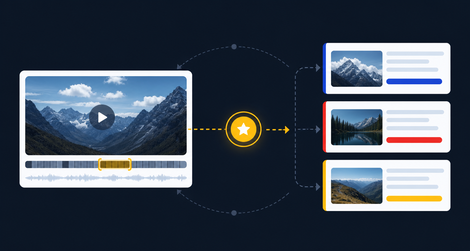
A Clip Opportunity Map helps with exactly this.
It looks at your long videos and gives you ideas what moments are worth clipping, why they matter, and how they could warm up the right people before they ever land on your offer.
It also checks your titles and thumbnails, so you can get more views on your pillar content. Yummy side-effect.
And the best part?
It is free.
You can audit 3 of your videos in detail and see what is worth repurposing first.
Why B2B Teams Need Source Selection
Here is where most repurposing goes wrong.
You open a long video, look for something with energy, cut 45 seconds, add captions, and post it.
Sometimes it works.
Sometimes it even gets views.
But views are a funny thing.
A clip can get attention and still bring you absolutely zero useful business outcome.
No warmer audience. No better trust. No clearer offer. No person thinking "ok, maybe I should talk to them."
For expert-led businesses, that hurts.
Because you are not posting just to feed the machine. You are posting because your content should help the right people understand your thinking, trust your method, and maybe take the next step.
And yes, the market still rewards good source material.
Wistia's 2026 State of Video report says product videos and webinars are among the formats teams connect most with business impact. It also says long-form still works when intent is high.
HubSpot's 2026 marketing statistics point in the same direction. Video still drives ROI for many teams, and blog plus SEO still matter.
So if you have a podcast, webinar, demo, workshop, or founder video, that one source can do a lot.
It can become a trust-building clip.
It can become a post.
It can become a blog section.
It can become something your sales team sends to a warm lead.
But only if you pick the right part first.
Because AI tools now make it stupidly easy to turn one recording into ten assets. That does not mean those assets are useful.
YouTube's own monetization policy says original, authentic, materially varied content matters. It also calls out repetitive or mass-produced content as a risk.
So before you cut anything, look at the source like a business asset.
Where did you answer a question buyers actually ask?
Where did you explain something that usually takes 20 minutes on a sales call?
Where did you tell a client story that makes your work feel real?
That is usually where the good stuff starts.
Start With Buyer Relevance, Not Energy

A lot of clips look good on the surface.
Someone says something punchy. The face looks expressive. The line feels clean. Easy win, right?
Maybe.
But if you sell expertise, energy alone is not enough.
The best clip is often not the loudest part.
It can be the quiet explanation at minute 23 where you finally explain why the old way keeps failing.
It can be the moment where your guest tells a real story.
It can be the small answer that removes fear before someone ever books a call.
Those moments do not always scream "viral clip".
But they can warm up the right buyer much better.
This is why a content repurposing workflow should start before editing.
The source needs a quick business check first.
Then the best moments can become clips, posts, blog sections, emails, key-idea visuals, or follow-up assets.
Editing matters.
But selection comes first.
The Five Moments To Look For First
When you open a long-form source, don't start by asking "what format should this become?"
Start with the moment.
These five usually matter most.
1. The Buyer Objection
This is the part where you answer the doubt that stops people from buying.
For a consultant, it might be: "Why does this take more than one session?"
For a B2B founder, it might be: "Why should we fix the process before hiring more people?"
For a coach, it might be: "Why does this not work when I try it alone?"
That is the kind of answer that works in public and in sales.
A short clip can open the loop. A LinkedIn post can explain it more. A blog section can rank for the question. A sales email can send the same answer to someone who is almost ready, but not quite.
Very useful little machine.
2. The Proof Moment
Proof is not always a polished case study.
It can be a before-and-after story.
A client quote.
A failed attempt.
A delivery lesson.
Or just a pattern you have seen so many times that you can say it without pretending.
The key is simple: does this moment make your method feel real?
If your podcast guest explains what changed after they fixed their sales process, that is proof.
If your webinar shows a messy dashboard turning into a clear plan, that is proof.
If your founder video names a mistake you made and what you changed, also proof.
These moments should usually beat generic advice.
3. The Framework
A framework moment turns your thinking into something people can reuse.
Could be a three-step method.
Could be a diagnostic question.
Could be a scoring system.
Could be your way of naming a problem that everyone feels but nobody has words for.
This is where a video repurposing service should add judgment.
A normal editor may cut the cleanest minute.
A stronger repurposing process asks: is there an idea inside this minute that people can remember and use?
If yes, that is a strong candidate.
4. The Offer-Clarity Moment
Sometimes the best content is the part where your offer finally makes sense.
Not the hard pitch.
The moment where the listener understands what you do, who it is for, and why the old way is painful.
These moments are easy to miss because they sound obvious to you.
But to a buyer, they can be the missing bridge.
If your source has one of these moments, don't bury it.
Use it on the website. Use it in outreach. Use it in nurture. Use it anywhere people need to understand what you do faster.
5. The Full-Source Door
Some clips should push people back to the full video.
This matters for podcasts, webinars, and long YouTube videos.
A clip that explains the whole thing may get views, but it gives people no reason to watch more.
A better clip opens a useful question.
Then the full source gives the deeper answer.
That is how short-form and long-form should work together for expert-led teams.
Short asset gets attention.
Full source builds trust.
The Buyer-Relevance Scorecard

Before you send the video to an editor, ask this:
Would this moment help the right person trust us more?
If yes, good. Keep going.
Then check a few simple things.
Does it answer a real buyer question?
Does it show proof, not just opinion?
Does it make your offer easier to understand?
Could it become more than one asset?
Could it send people back to the full video?
Will it still make sense 6 months from now?
You can score it if you want.
0 means weak.
1 means useful, but not urgent.
2 means strong first-batch candidate.
If a moment scores around 10 or more, it probably deserves attention first.
If it lands around 7 to 9, save it for the second batch.
Below that? Maybe skip it unless you need it for a specific campaign.
You do not need a fancy system for this.
Just don't let a random high-energy clip steal the spot from a moment that could actually help your business.
Examples By Source Type
A webinar often hides good objection moments.
The best part may not be the prettiest slide.
It may be the live answer after someone asks why the old process keeps failing.
If your archive is webinar-heavy, read the webinar repurposing service guide next. It goes deeper into what to pull from that kind of source.
A podcast often hides proof and trust.
The guest story may be stronger than the host intro.
The sharpest clip may come from a small tangent where the guest names a mistake and explains the fix.
For podcast-led teams, the podcast repurposing service guide shows what a stronger repurposing process should include.
A demo often hides offer clarity.
The best moment may be the before-and-after, not the feature tour.
That clip should help the buyer understand the problem faster.
A founder video often hides point of view.
The first useful asset may be a short opinion that explains why the market is solving the wrong problem.
That kind of moment can become a post, a clip, a key-idea visual, and even a blog intro.
When To Use A Tool, Editor, Or Service
Sometimes a tool is enough.
If you already know the exact timestamps, the channels, and what "good" looks like, go for it.
Use the tool.
Sometimes an editor is enough.
If the strategy is clear and you just need cutting, pacing, captions, layout, and export, an editor can do the job.
But if you have strong source material and you don't know what to extract, you need a more strategic process first.
That may be a content repurposing service, a content repurposing agency, or a focused map-first sprint.
The real question is where you are stuck.
If you are stuck on editing, get editing help.
If you are stuck on judgment, fix selection first.
The guide on content repurposing service vs video editor goes deeper on that choice.
And if you are deciding between doing it yourself or getting help, compare the tradeoffs in DIY vs done-for-you content repurposing.
How ContentFries Handles The First Choice
ContentFries starts with a simple idea:
Map before editing.
Look at the source first.
Then decide what deserves to become content.
The Clip Opportunity Map checks your videos and looks for buyer-relevant moments.
It does not assume that every energetic quote deserves a clip.
It looks for moments that can support trust, offer clarity, and follow-up content.
From there, one source can turn into a useful first batch:
clips that open a buyer-relevant idea
posts that explain the point in plain English
blog sections that turn spoken expertise into search content
key-idea visuals that make one useful point easy to share
email or sales follow-up angles for warm leads
This is also why the article on how to turn 1 video into a week of content starts with a source plan.
More output only helps when the first choice is not random.
Final Decision
Start with the moment that does business work.
A client story.
A strong answer.
A proof moment.
A simple explanation of your method.
A part where your offer suddenly makes more sense.
That is usually a better first clip than the part that only looks good in the editor.
And if you do not want to guess, run a free private Clip Opportunity Map.
It checks 3 of your videos in detail and shows what is worth turning into clips, posts, blogs, and sales-support content first.